


As the demand for functional and sustainable pet nutrition continues to grow, protein hydrolysis has emerged as a key technology in the development of advanced feed ingredients. Among these, hydrolysed proteins play an important role in improving digestibility and functional bioactivity. Hydrolysed protein is defined as protein with reduced molecular weight after being subjected to the process of hydrolysis, that is the use of water to break the peptide bonds (Hou et al., 2017).
The aim for feeding hydrolysed protein or novel protein is to provide sufficient protein to the pets without or reduced risk of triggering an immune overreaction (Mueller et al., 2001). Hydrolyzation also increases the digestibility of the protein making it easier to be absorbed (Mensiena et al., 2018).
Hydrolysed protein uses normal protein source commonly available. In pet nutrition, a novel protein typically refers to an uncommon or new animal or plant protein ingredient introduced into a diet, especially for managing food allergies or sensitivities. A novel protein, fed long term for a lengthy period of duration, could potentially elicit new allergenic response in the pets, and will no longer be novel. This is because the refractory period before an allergy presents itself can be as short as few minute to as long as two years.
Hypoallergenic pet food formulations are typically based on three main strategies: restricting the number of protein-containing ingredients, incorporating novel protein sources, and excluding components that are commonly associated with allergic reactions. The underlying concept is that animals are unlikely to have been previously exposed to novel protein sources; therefore, they are less likely to have developed sensitization or an immune response to these ingredients (Beynen, 2016).
The most reliable way to create a truly nonallergenic diet is through the use of purified amino acids and small peptides. However, these elemental products are often cost-prohibitive, have low patient acceptance, and are challenging to administer enterally due to their exceptionally high osmolarity. Therefore, instead of the perpetual quest for novel protein and feeding of hypoallergenic diet, feeding of hydrolysed mainstream and commonly available protein could be the better option, both in terms of availability and cost effectiveness, for the diagnostic and long-term management of allergy in pets.
What is ProCare™?
ProCare™ is hydrolyzation of protein into smaller peptides and free amino acids using patented bacteria composition from Japan. This process naturally makes the protein less allergenic, as they are no longer recognized by the immune system, thereby reducing the risk of developing skin allergy.
Hydrolyzation can be categorised into 3 groups, such as mild, partial, and extensive, which are based on their degree of hydrolyzation, which measures how extensive the protein has undergone hydrolyzation, thereby indicating the size of the peptide fragments in the hydrolysate (Mensiena et al., 2018). Partially hydrolysed protein is often used for reducing food related allergy and extensively hydrolysed protein is used for improving digestion (Mensiena et al., 2018).
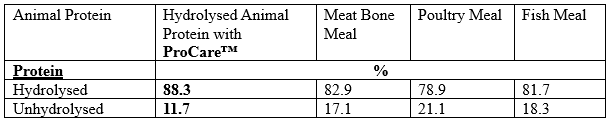
Table 1 showed the degree of hydrolysis was highest in animal protein hydrolysed using ProCare™ technology at 88.3%, followed by meat bone meal (82.9%), fish meal (81.7%), and poultry meal (78.9%), with unhydrolysed protein fraction lowest in animal protein hydrolysed using ProCare™ technology (11.7%) and highest in poultry meal (21.1%). This indicates ProCare™ technology digested animal protein may have reduce allergenicity and supports its use in hypoallergenic formulations, despite contains lower crude protein and amino acids compared to conventional animal protein meals.
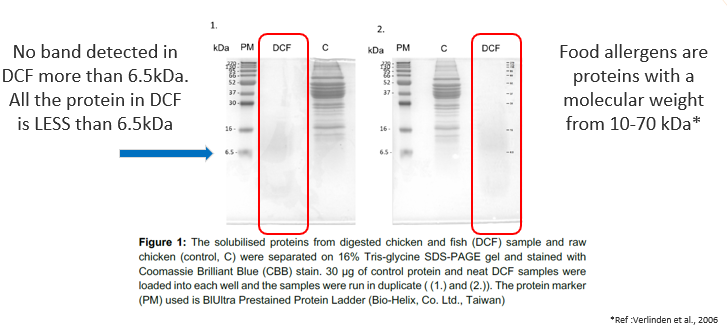
How small is small enough? Cross linking of two or more IgE molecules bound by FcℇR1 IgE receptors on the surface of mast cells is required for Type 1 hypersensitivity reactions to occur. Therefore, there is a minimum size on the size of the protein to act as an allergen (Cave & Guilford, 2004). Various studies done by researcher in the past provided different minimum size limit ranging from 10 kDa (Taylor et al., 1987, Lehrer et al., 1996), 3 to 5 kDa (van Beresteijn et al., 1994), at minimum of more than 1.4kDa (Van Hoeyveld et al., 1998 and between 1.4 to 0.97 kDa (Cave & Guilford, 2004). In a molecular weight analysis conducted at University Putra Malaysia, as shown in Figure 1, no protein bands above 6.5 kDa were detected for DCF, the hydrolysed animal protein produced using ProCare™ technology, in comparison, multiple bands of proteins were detected from ~10 kDa to 270 kDa for the raw chicken sample (control) and poultry meal (positive control).
Ensuring that a hydrolysate contains no peptides larger than 3 kDa, or ideally 1 kDa, would maximize the likelihood of removing any residual allergens. But even this does not guarantee zero hypersensitivity will occur. Reduction of molecular weight of a protein does not guarantee reduction of allergenicity or reduce the risk of eliciting an immune-mediated reaction to zero (Cave, 2006).
Although no study has been done in cats on the degree of protein hydrolyzation in relative to the clinical improvement or worsening of clinical signs as a result of allergy, study in dogs indicated all recognized protein allergens has molecular weight of more than 20kDa (Ohmori et al., 2007). Determining the threshold below which remaining peptide fragments are sufficiently small to avoid clinical signs in sensitized patients is challenging (Cave, 2006).
ProCare™ Improves digestibility & beyond
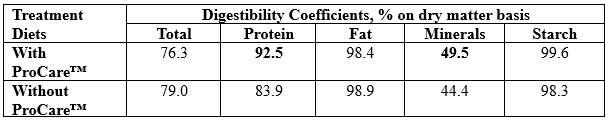
Hydrolysed protein increases the digestibility coefficient of a diet by breaking large protein molecules into smaller peptides and free amino acids before ingestion, effectively “pre-digesting” the protein source. This reduces the workload on gastric and pancreatic enzymes, allowing faster and more complete enzymatic action in the small intestine. Small peptides and amino acids are absorbed more efficiently through specialized intestinal transporters, improving nitrogen retention and reducing fecal protein losses. Additionally, hydrolysis enhances protein solubility and reduces structural resistance or anti-nutritional factors that may limit enzyme access. The overall result is higher crude protein digestibility, improved nutrient utilization, better stool quality, and enhanced feed efficiency in the finished formula. The digestibility coefficient tells how much of a nutrient (or feed/food) is actually digested and absorbed by the body, rather than just eaten and then excreted. Table 2 shows the result of digestibility study conducted in University of Bologna in treatment diet with and without ProCare™, suggest that not only ProCare™ enhances protein utilization but also contributes to more efficient mineral uptake.
Why ProCare™?
Protein hydrolysis into amino acids can be achieved through chemical (acidic or alkaline), enzymatic, or microbial methods. The selection of the hydrolysis technique depends on the intended application, functional requirements, and characteristics of the protein substrate. Chemical hydrolysis is relatively cost-effective and can be conducted at large scale; however, the harsh processing conditions, particularly strong acids or alkalis at elevated temperatures, may lead to the degradation or racemization of certain amino acids, resulting in partial or complete loss of nutritional value (Hou et al., 2017). In contrast, enzymatic hydrolysis is carried out under mild pH and temperature conditions, thereby minimizing amino acid degradation and preserving functional properties (Hou et al., 2017). Commercial protease preparations are widely utilized due to their availability, specificity, and controlled catalytic activity. ProCare™ utilizes naturally produced microbial proteases to catalyse hydrolysation of protein resulting in the generation of peptides and amino acids under mild processing conditions. In microbial systems, extracellular proteases are synthesized and secreted to catalyse the hydrolysis of native proteins into high- and low-molecular-weight peptides, as well as free amino acids. The generated low-molecular-weight peptides may be actively transported across the cell membrane via specific uptake systems, where they undergo further intracellular enzymatic degradation to yield additional free amino acids for metabolic utilization. Beyond proteolytic activity, microorganisms express a broad spectrum of hydrolytic enzymes, including carbohydrases and lipases, which contribute to the depolymerization of complex carbohydrates and lipids.
Future of ProCare™
In modern animal nutrition, protein hydrolysis is increasingly applied as a value-enhancing strategy for industrial byproducts and plant-derived materials containing anti-nutritional factors. Through enzymatic processing, these substrates are converted into bioactive peptides suitable for incorporation into feed formulations, thereby improving nutrient bioavailability, enhancing protein digestibility, and supporting circular economy principles. This approach contributes to greater resource efficiency and increases the nutritional value of protein streams that would otherwise be discarded or directed to landfill, ultimately promoting more sustainable animal production systems.
Functional bioactive peptides generated through protein hydrolysis have been widely investigated for their contribution to digestive support as well as their multiple bio functional properties, including antimicrobial, antihypertensive, antioxidant, and immunomodulatory activities (López-Barrios, 2014 as cited in Hou et al., 2017). By supporting immune function and physiological balance, protein hydrolysates can play a role in preventive health strategies, shifting the focus from reactive treatment toward proactive health management through functional nutrition.
Summary
ProCare™ is positioned as a foundational ingredient across a wide range of pet food formulations, extending its benefits beyond premium segments to mainstream applications. By broadening accessibility, this technology enables functional nutrition to reach a larger consumer base while aligning with the growing demand for health-focused and sustainable solutions. Through its contribution to digestive function, physiological balance, and overall well-being, ProCare™ supports long-term companion animal health and responsible product innovation.
From a product innovation and consumer perspective, the advancement of ProCare™ technology represents a meaningful step toward making functional nutrition more accessible to everyday pet owners. This same hydrolysed protein technology is also applied in ProDiet and ProBalance formulations, bringing the benefits of improved digestibility, reduced allergenicity, and enhanced nutrient utilization into complete and balanced daily diets. By integrating scientific innovation into mainstream recipes, ProDiet and ProBalance help translate advanced nutritional research into practical, trusted solutions that support long-term pet health while meeting the evolving expectations of modern pet parents.
References:
Beynen, Anton. (2016). Hypoallergenic pet foods. 10.13140/RG.2.2.18948.12166.
Cave, N. J., & Guilford, W. G. (2004). A method for in vitro evaluation of protein hydrolysates for potential inclusion in veterinary diets. Research in veterinary science, 77(3), 231–238. https://doi.org/10.1016/j.rvsc.2004.04.011
Cave N. J. (2006). Hydrolysed protein diets for dogs and cats. The Veterinary clinics of North America. Small animal practice, 36(6), 1251–vi. https://doi.org/10.1016/j.cvsm.2006.08.008
Hou, Y., Wu, Z., Dai, Z., Wang, G., & Wu, G. (2017). Protein hydrolysates in animal nutrition: Industrial production, bioactive peptides, and functional significance. Journal of animal science and biotechnology, 8, 24. https://doi.org/10.1186/s40104-017-0153-9
Lehrer, S. B., Horner, W. E., & Reese, G. (1996). Why are some proteins allergenic? Implications for biotechnology. Critical reviews in food science and nutrition, 36(6), 553–564. https://doi.org/10.1080/10408399609527739
Mensiena, B. G. Kiewiet, Marijke M. Faas, & Paul de Vos. (2018). Immunomodulatory Protein Hydrolysates and Their Application. Nutrients, 10(7), 904.
Muller, G. H., Kirk, R. W., & Scott, D. W. (2001). Food hypersensitivity. In J. Dyson (Ed.), Small animal dermatology (6th ed., pp. 624–626). Philadelphia: WB Saunders.
Ohmori, K., Masuda, K., Kawarai, S., et al. (2007). Identification of bovine serum albumin as an IgE-reactive beef component in a dog with food hypersensitivity against beef. The Journal of Veterinary Medical Science, 69, 865–7.
Taylor, S. L., Lemanske, R. F., Jr, Bush, R. K., & Busse, W. W. (1987). Food allergens: structure and immunologic properties. Annals of allergy, 59(5 Pt 2), 93–99.
VAN Beresteijn, E. C. H., Peeters, R. A., Kaper, J., Meijer, R. J. G. M., Robben, A. J. P. M., & Schmidt, D. G. (1994). Molecular Mass Distribution Immunological Properties Nutritive Value of Whey Protein Hydrolysates. Journal of food protection, 57(7), 619–625. https://doi.org/10.4315/0362-028X-57.7.619
Verlinden, A., Hesta, M., Millet, S., et al. (2006). Food allergy in dogs and cats: a review. Critical Reviews in Food Science and Nutrition, 46, 259–73.
© 2026 Pet World Nutritions Sdn Bhd. All rights reserved.