

A cat urinating somewhere it should not is one of the most common reasons cats are brought to a veterinary clinic, but also one of the most common reasons cats are given up by their owners.
Before anything else, this is the first thing owners should check for their cats:
If your cat is straining in the tray and producing little or no urine, crying while trying, licking repeatedly at the genital area, or vocalising and restless, treat it as an emergency and visit a vet.
What Actually Causes It, With Numbers
The umbrella term is feline lower urinary tract disease (FLUTD), and this is where most owner assumptions fall apart. In cats under ten years of age, the breakdown of causes is approximately:
| Cause | Share of FLUTD cases |
|---|---|
| Feline idiopathic cystitis | 55 – 63% |
| Urolithiasis (stones, including struvite and calcium oxalate) | 15 – 22% |
| Urethral plugs | 10 – 21% |
| Bacterial urinary tract infection | Under 1 – 8% |
| Neoplasia | Under 1 – 2% |
Source: Today’s Veterinary Practice, Diagnosing and managing feline lower urinary tract disease.
Referring to the top row: Feline idiopathic cystitis accounts for well over half of cases. Put simply, it is bladder inflammation with no identifiable stone, crystal or infection behind it, closely associated with stress, and it presents with urethral obstruction in 15 to 20% of cases.
All of these conditions produce overlapping signs. Straining, blood in the urine, frequent small volumes, and urinating outside the tray appear across the whole list. It would be difficult for owners to determine the real condition just by watching the cat.
Behavior Is a Separate Thing
However, not every cat urinating outside the tray has urinary disease at all. Inappropriate elimination can come from litter tray management: too few trays, trays that are too small, hooded trays, a litter the cat dislikes, trays cleaned too rarely, or a tray placed somewhere noisy or hard to reach. A common starting point is one tray per cat plus one spare, in separate locations, uncovered, scooped daily.
It can also come from social stress between cats in the household, from a new animal or person, from building work, or from pain elsewhere, such as arthritis making a high-sided tray hard to climb into.
Spraying, which is urine marking on vertical surfaces is also more often behavioural.
How a Veterinarian Tells Them Apart
Diagnosis involves a physical examination including bladder palpation, urinalysis with pH, specific gravity and sediment examination, and often imaging to look for stones. Culture may be added where infection is suspected, and bloodwork where obstruction or kidney involvement is a concern.
That sequence is what separates a cat needing a struvite-dissolution diet from a cat needing pain relief and environmental change, which are two totally different routes.
Where ProVet+ Cat Urinary Support Fits
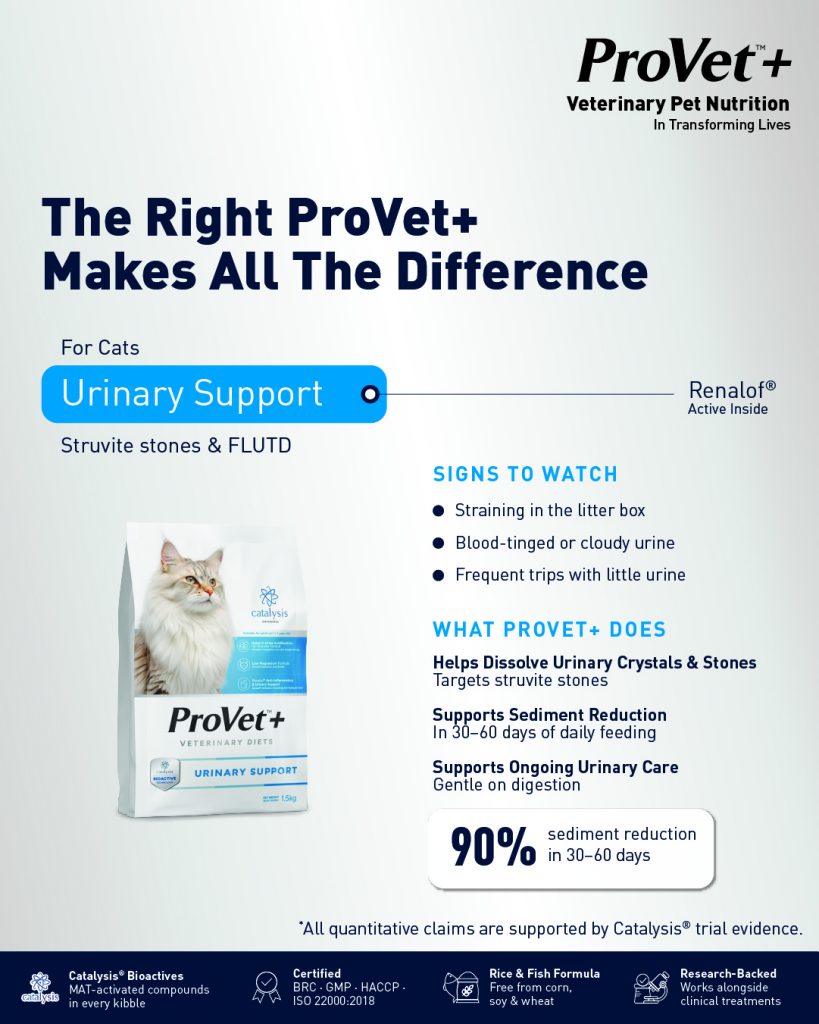
ProVet+ Cat Urinary Support is a struvite-targeting veterinary diet, also formulated to soothe the bladder and urinary tract.
ProVet+ Cat Urinary Support is a struvite-management veterinary diet:
Magnesium is capped at 0.08% maximum, which limits the availability of one of the mineral components of struvite. And urine is acidified two ways: methionine as a direct acidifier, plus naturally acidifying sulfur-containing proteins from fish meal, salmon peptide, tuna hydrolysate and digested animal protein, working toward a target urine pH of roughly 6.0 to 6.5.
Published trial data supports this general approach. In a randomised multicentre trial of two low-magnesium, urine-acidifying diets, 32 of 37 cats achieved complete dissolution of struvite uroliths, with faster resolution at the lower of the two mean urinary pH values tested, 6.08 against 6.43 (Lulich et al., 2013).
Layered on that foundation is RENALOF®, a powerful phyto-therapeutic bioactive built around activated Agropyron repens, providing soothing and anti-inflammatory support to the bladder lining. Cranberry powder is also included for its anti-adhesion effect against bacterial attachment, and the formula also carries taurine at 0.20% minimum and EPA and DHA at 0.30% minimum.
Important Note:
- Because struvite stones make up only a fraction of that 15–22% urolithiasis group, a struvite formula won’t resolve idiopathic cystitis. Because of this, we always recommend pairing medical treatment with a veterinary-supported diet, as both must work closely hand in hand.
- ProVet+ Cat Urinary Support is not formulated as a renal diet. Designed with deliberate urinary acidification and moderate protein levels (29.0% minimum), its mechanism runs counter to chronic kidney disease nutritional guidelines. As a dedicated ProVet+ renal product is not yet available in our lineup, practitioners should seek alternative formulations for CKD management.
What Every Cat Benefits From and What all Pet Owners Should do Now!
Some measures help across all of these conditions.
Increase water intake: More bowls in more places, wide and shallow, kept clean and away from food. Adding wet food to the diet raises total water intake meaningfully.
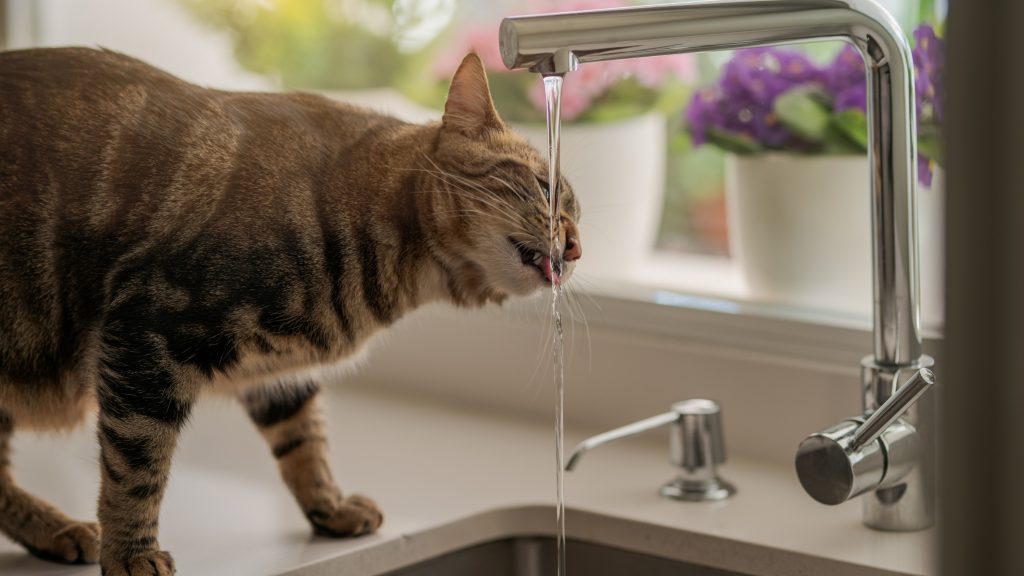
Many cats also prefer to drink from moving water.
Reduce stress: Predictable routine, enough separate resources for multiple cats, vertical space and hiding places, and gradual introductions.
Litter box arrangement: To keep your cats happy and reduce stress, follow the golden rule of litter box care: one box per cat plus one extra. Keep them large, uncovered, scooped daily, and tucked into quiet, accessible spots.
What to Do This Week
If your cat cannot pass urine, call a clinic now.
If struvite urolithiasis is diagnosed or suspected, ask your veterinarian about ProVet+ Cat Urinary Support and how long your cat should be on it, because a dissolution protocol is time-limited by design.
ProVet+ Cat Urinary Support is one of six ProVet+ veterinary diets for cats and for dogs, formulated as prescription pet food for pets with diagnosed conditions and dispensed through licensed veterinary clinics.
*all quantitative medical claims are supported by Catalysis® trial evidence.