

If you pick up any pack of pet food in the market, the protein number is usually printed in bold – 30%. 34%. 40%. It is typical that owners would be include to choose the highest one.
For a healthy pet, that number is a fair guide. For a sick or recovering pet, it can mislead you. The label measures how much protein is in the bag. However, how much your pet absorbs is a separate question.
Protein absorption matters most after surgery or during a long illness. It matters too when a pet has stopped eating and is losing muscle. This guide explains the difference and how to feed a recovering pet well.
What “crude protein” on the label means
The word “crude” is there for a reason. The guaranteed analysis gives a rough estimate of the amount of protein. It does not describe the quality of that protein (Cooperative Extension, Pet Food Labels).
In short: two foods with the same protein number can perform very differently in the gut.
A 2023 study tested 18 commercial dry dog foods, which revealed that Crude Protein ranged from 14.4% to 42.5%. Meanwhile, their estimated Protein Digestibility ranged from 72.2% to 88.7%. The authors concluded that protein digestibility varies widely among dog foods (Song & Kim, 2023, Animals).
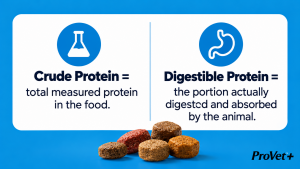
Two foods with the same protein number can perform very differently in the gut.
A simple example
Here is an illustration of why digestibility matters. The numbers are rounded for clarity.
| Measure | Food A | Food B |
|---|---|---|
| Protein on the label | 30% | 27% |
| Share the gut can digest | 72% | 90% |
| Digestible protein per 100 g | about 21.6 g | about 24.3 g |
Despite having a lower crude protein%, Food B still delivers more usable protein for the gut.
In a sick pet, illness and inflammation both reduce how well the gut absorbs nutrients – which puts the importance of protein digestibility even higher.
Why muscle loss matters in sick pets
When a sick pet does not get enough protein, the body breaks down its own muscle for amino acids.
Vets call this cachexia when it happens with disease. It is seen in heart disease, kidney disease and cancer. In older pets without disease, muscle loss is called sarcopenia. Both are linked to more illness and shorter survival (Freeman, 2012, Journal of Veterinary Internal Medicine).
Muscle is also the body’s protein reserve for healing. Our immune system relies on protein.
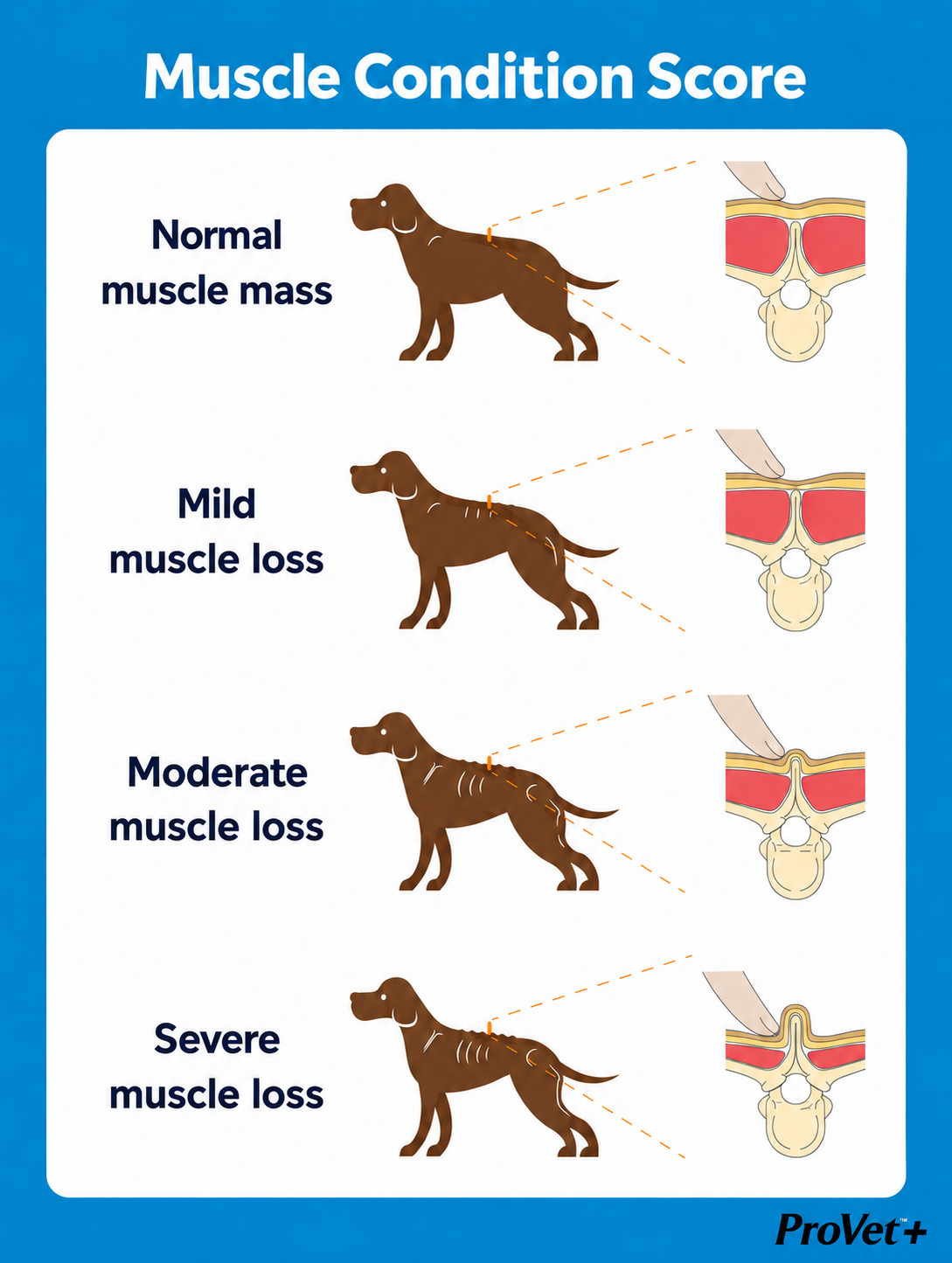
Sick and recovering pets lose muscle quickly when they do not eat enough.
Eat well, heal fast: Get your pet home sooner!
A Brazilian study followed 467 dogs and 55 cats in hospital. Animals that took in more energy were more likely to be discharged. Of those that ate voluntarily, 92.9% went home. Of those that received no calories, 38.4% went home (Brunetto et al., 2010, Journal of Veterinary Emergency and Critical Care).
This does not prove that food alone saved them. Sicker animals eat less. Still, the link between eating and recovery is strong enough that vets treat appetite as a clinical priority.
How to feed a recovering pet
Always follow your vet’s plan. These are the general principles vets use.
Work out the resting energy need. Vets use the formula RER = 70 × (body weight in kg)^0.75. A 4 kg cat needs about 198 kcal a day at rest. A 20 kg dog needs about 662 kcal.
Start slowly after a long fast. Vets often start at 25 to 50% of RER on day 1, depending on how long the pet has not eaten. They then increase to 100% over 2 to 4 days (Lenox, 2021, Today’s Veterinary Practice).
Feed small meals often. Three or four small meals are easier on a recovering gut than one large one.
Warm the food slightly. Aroma drives appetite, especially in cats. Warm to body temperature, never hot.
Weigh your pet every week. Weight loss during recovery is a reason to call your vet.
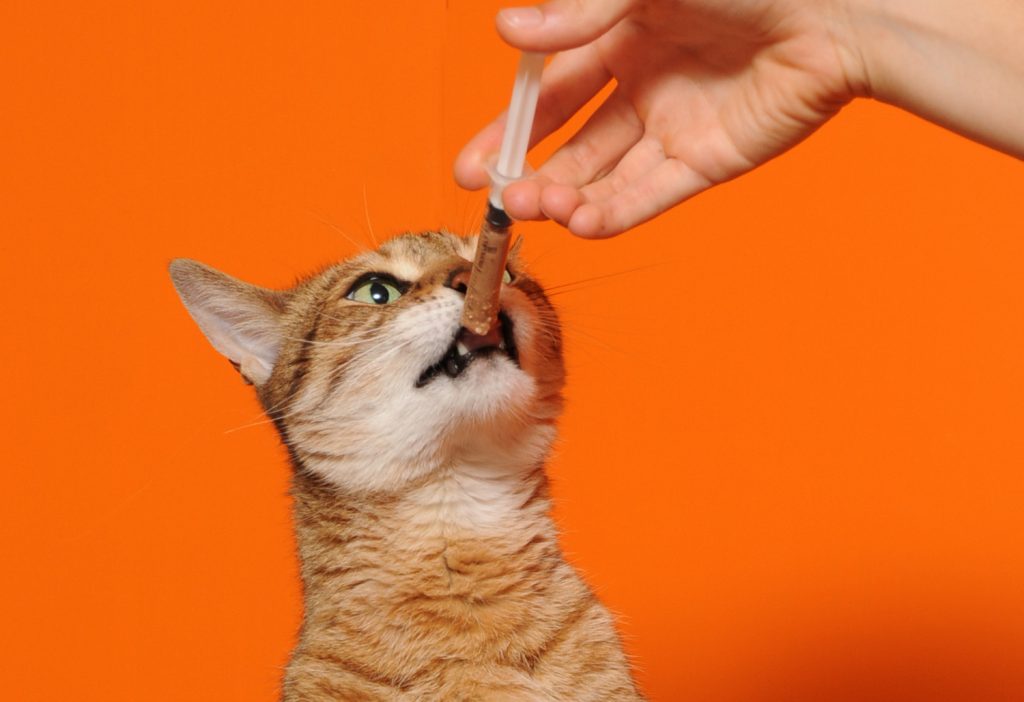
A pet that cannot eat on its own needs a liquid critical-care diet first.
How ProVet+ Vitality Support is built for recovery
ProVet+ Vitality Support is the ProVet+ pet food for adult pets in recovery or with long-term illness, and for ageing pets. It is made for cats and for dogs.
- Hydrolysed protein. Salmon peptide and tuna hydrolysate are broken down to below 6.5 kDa during manufacturing. The gut has less work to do.
- Digestibility. Pet World’s protein specification gives pepsin digestibility above 90%. A common benchmark for a highly digestible therapeutic diet is about 87% (Cesarani et al., 2020).
- High protein. 32% minimum for cats and 27% minimum for dogs.
- Energy density. About 3,400 kcal/kg for cats and 3,500 kcal/kg for dogs, so a small meal carries more energy.
- EPA and DHA at 0.80% minimum, the highest omega-3 level in the ProVet+ range.
- OCOXIN®, a Catalysis® blend of green tea polyphenols, licorice extract and amino acids. The manufacturer formulates it with a liver aroma intended to support appetite.
The bottom line
For a recovering pet, the protein your pet can absorb matters more than the “protein %” on the bag. Feed a highly digestible, energy-dense diet in small meals, and track weight every week.
Ask your vet whether a ProVet veterinary diet such as ProVet+ Vitality Support is right for your pet’s recovery. Good food for pets in recovery gives the body what it needs to rebuild.
*all quantitative medical claims are supported by Catalysis® trial evidence